“it is easy to forgive a small child afraid of the dark, but not a full-grown man afraid of the light.”

Showing posts with label unable to work. Show all posts

Sunday, September 13, 2009

GUINEA WORM


Condition
: Guinea worm, also known as Dracunculiasis, is a crippling condition caused by a water-borne parasite. Between 1986 and 2008, the prevalence of the disease dropped from 3.5 million to 5,000. However, it continues to be endemic in 6 African countries. Guinea worm is one of the oldest recorded diseases, and it has been found in calcified Egyptian mummies.
Causes: The primary cause of guinea worm is a lack of clean water. Guinea worm larvae are present in contaminated water sources, and are eaten by a water flea. When a person drinks the water, they also ingest the flea and the larvae. Once inside the stomach, the flea is consumed by stomach acid, but the larvae remains and migrates throughout the body tissues. After approximately one year, the guinea worm is fully mature, and it emerges through a painful blister in one of the lower extremities. People often submerge the affected extremity in a water source to relieve the pain, and when they do so, the mature worm releases thousands of larvae into the water source, thus continuing the cycle.
Effects: As stated before, when the guinea worm begins to emerge from the skin, it is extremely painful for the victim. They often experience fever and intense burning and itching. Due to the pain, people are unable to work or attend school for up to three months. In agricultural areas, this means food shortages, lower earnings, and detrimental effects on local economies.
Treatment: Once a person is infected with guinea worm, treatment is gruesome. As the worm, which is several centimeters long and has the circumference of a spaghetti noodle, emerges from the body, a health care professional must pull it a few millimeters each day until it is freed from the body. This painful process can take several weeks, during which time victims are often unable to walk. Obviously, prevention is key, and behavioral changes are crucial. Prevention
efforts include improved water supply, the use of water filters, and community education. There are numerous international campaigns to prevent guinea worm, and it is hoped to be completely eradicated in the very near future.
Recent News about Guinea Worm:
Head of State Says Nigeria Has Conquered Guinea Worm
Ghana On Course to Eradicate Guinea Worm
End in Sight for Guinea Worm

If YOU want to do something about Guinea Worm, YOU can support these organizations:
The Carter Center
UNICEF (United Nations Children’s Fund)
Bill and Melinda Gates Foundation
Living Water International


Thursday, August 27, 2009

ELEPHANTIASIS

Condition: Elephantiasis, or lymphatic filariasis, is a disfiguring condition caused by microscopic, parasitic worms. Currently, there are 120 million people infected, and one-third of those people are seriously incapacitated by it. It is most prevalent in Africa and Southeast Asia, especially in India. It is more common in men than in women, and in endemic communities, up to 50% of men and 10% of women may be affected.
Causes: The parasites are spread from human to human by mosquito bites. It is very common in poor, densely populated areas. Once inside the body, the worms and their offspring clog the lymphatic vessels causing an immune response and extreme swelling in the victim.
Effects: The effects of elephantiasis are extreme. The most visible effect is acute swelling primarily in the lower extremities, especially the legs, feet, and genitals. Swelling can also occur in the torso, arms, breasts, and even the face. In addition to the visible swelling, elephantiasis can damage internal organs as well. In many communities, there is a social stigma against those infected, and they often suffer from psychological and emotional issues.
Treatment: The treatment for elephantiasis is not clearly defined. However, a combination of drugs, which varies depending on the region, along with rigorous cleaning of the affected area has proved effective. Two drug companies, SmithKline Beecham and Merck, have collaborated with the World Health Organization, and have agreed to donate doses of their respective drugs, albendazole and ivermectin, until the disease is eradicated. Several other organizations have also joined the fight, and it is hoped that the disease will be completely eradicated by 2020.
Recent News about Elephantiasis:
New DNA Coding to Track Mosquitoes
Campaign to End Elephantiasis in Fiji Continues

If YOU want to do something about Elephantiasis, YOU can support these organizations:
The Global Alliance to Eliminate Lymphatic Filariasis

The Carter Center

Tuesday, August 11, 2009

OBSTETRIC FISTULA


Condition: Obstetric fistula is a devastating injury that occurs during childbirth. During labor, a hole is formed between the vagina and the bladder. It occurs primarily in sub-Saharan Africa and in parts of Asia. Currently, over 2 million women are living with untreated obstetric fistula, and there 50,000-100,000 new cases each year.
Causes: The primary cause of obstetric fistula is prolonged and/or obstructed labor. When a baby is in the birth canal for a long period of time, the blood flow is cut off to the surrounding tissues, and they rot away. This causes a hole between the vagina and the bladder. The condition is more prevalent in areas where girls are married at young ages. Their bodies are not fully developed, and they are physically incapable of delivering a baby. Malnutrition also plays a role, as it prevents a woman's body from developing properly. Women who live in rural areas are also more prone to developing obstetric fistula. It may take days to travel to the nearest hospital, and the costs and logistics of transportation make it nearly impossible. Therefore, women may be in labor for several days with no access to a cesarean section. In many cases the baby dies, and the women are left with a devastating fistula. Social factors, such as poverty, cultural beliefs, lack of education about proper birthing procedures, and the role of women play a part as well.
Effects: Women with obstetric fistula are constantly leaking urine, which causes a very unpleasant odor. They are often times outcast by their families, because they are considered "unclean" and are sometimes made to live in isolation. The emotional toll is sometimes unbearable, and suicide is common among women with this condition.
Treatment: The treatment for obstetric fistula is a surgical repair of the hole. This surgery has a 90% success rate in uncomplicated cases. It costs about $300, however, which is impossible for many women. The lack of local doctors to perform the surgery is a problem, as well as lack of knowledge about the surgery. There are also various alternatives for women for whom the surgery doesn't work.
Recent news about Obstetric Fistula:
Women Under Obstetric Attack
Kenya: Campaigns Intensify to Eradicate Women's Disease
The Ugly Face of Fistula

If YOU want to do something about Obstetric Fistula, YOU can support these organizations:
UNFPA (United Nations Population Fund-End Fistula Campaign)
The Fistula Foundation
International Organization for Women and Development
The Fistula Care Project
Operation OF

Wednesday, August 5, 2009

RIVER BLINDNESS


young children leading blind adults.

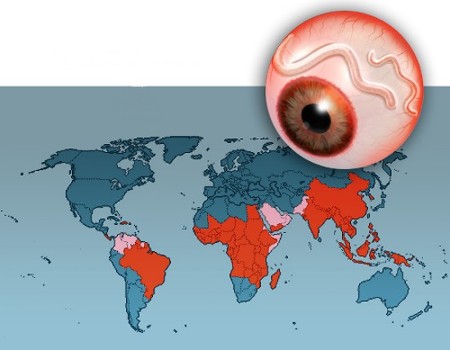
Disease: Onchocerciasis, more commonly known as River Blindness, is one of the leading causes of preventable blindness in the world. It is an infection caused by a parasitic worm, and it is spread through the bite of the black fly. There are currently 37 million people infected with the parasite, and 99% of those people live in sub-Saharan Africa.
How it's spread: As the black fly (the vector) bites an infected person, the worms travel from the infected person to the body of the fly. The black fly then bites another person, and the worms travel from the fly to the second person. A person must be bitten more than once, however, to contract the infection. Once inside the body, the worms mate and create millions of offspring, which invade various parts of the body, including the eyes. As the offspring die off, the body has an inflammatory response. On the skin, this response causes severe rashes, and in the eyes, it causes blindness.
Effects: The social and economic effects of this infection are tremendous. Adults are unable to work because of visual impairment, and children are unable to go to school because they must help their parents. The cycle of poor education, poverty, and bad health continues, and entire communities ultimately suffer.
Cure: One dose per year of a drug called Ivermectin prevents the worms from reproducing in the body, and thus prevents the onset of symptoms and further transmission. The drug company Merck currently donates doses of the drug in many countries. To date, they have donated over 600 million doses. Although the treatment is so simple and economical, millions of people continue to suffer.
Recent news about River Blindness:
River Blindness Can Be Eradicated
River Blindness Can Be Stopped by Drugs

If YOU want to help do something about River Blindness, YOU can support these organizations:
The Carter Center
Helen Keller International (be sure to type in “Onchocerciasis” in the "Program to Support" field)
Living Water International